Tamper-evident
Evidence integrity can be verified across the execution lifecycle.
UnifyOps treats evidence as a first-class output of governed AI work — preserving what happened, what governed it, what was verified, and what outcome was reached.
Keep governed decisions and execution activity inspectable so enterprise teams can review what happened, what controlled it and what can be independently verified.
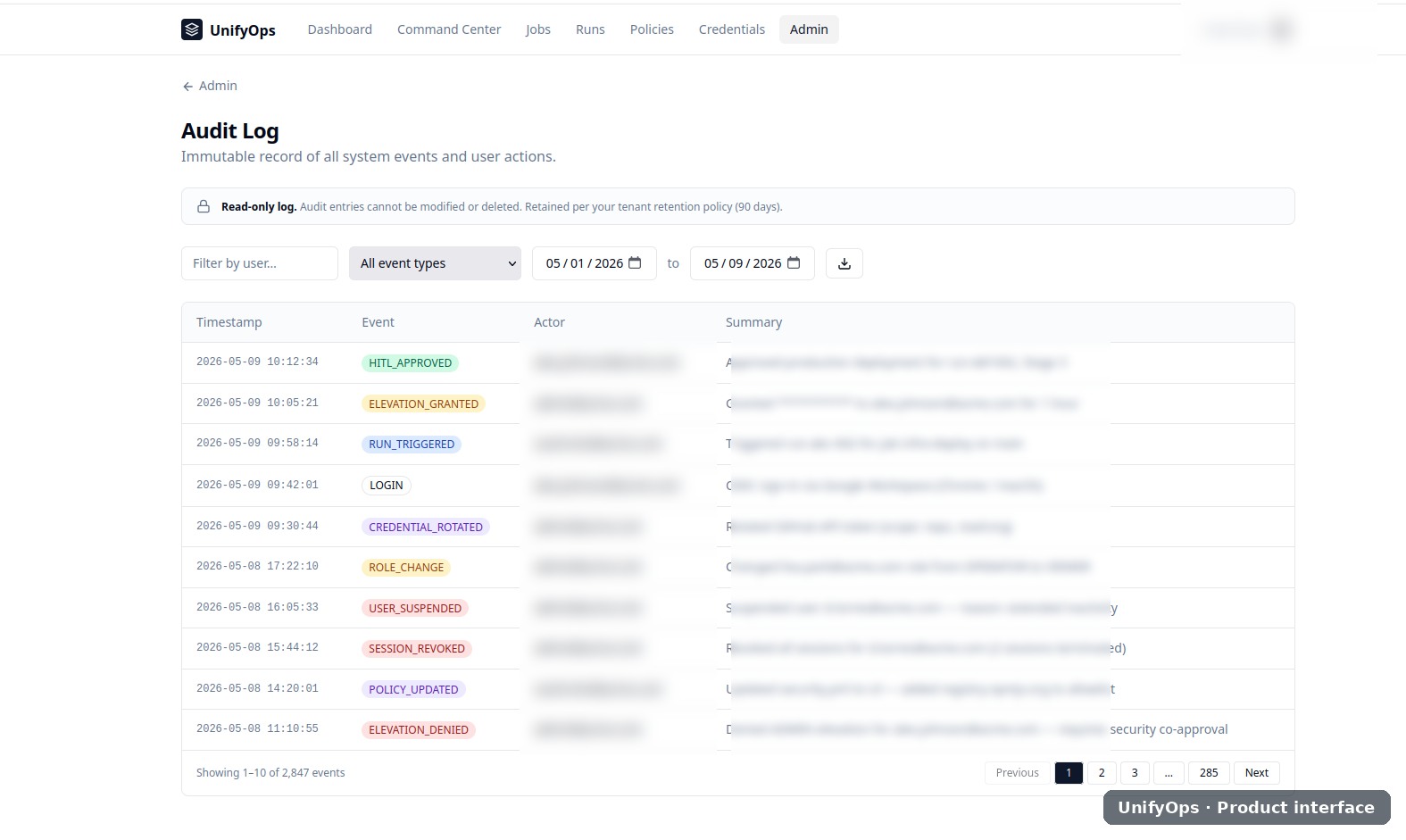
UnifyOps preserves a tamper-evident, integrity-verifiable record of governed AI execution, with controlled access and portable evidence for independent review.
Evidence integrity can be verified across the execution lifecycle.
Evidence remains governed by enterprise access and tenancy boundaries.
Evidence can be exported in standard formats for independent review, assurance and operational use.
Enterprise confidence depends on being able to inspect and verify how work was performed, not simply on accepting the final result.
Preserve the significant actions, state transitions and outcomes that shaped the work.
Retain the approvals, policy outcomes and governed decisions that allowed work to continue.
Keep the results of tests, evaluations, reviews and other assurance activities tied to the execution they assessed.
UnifyOps is designed so evidence remains durable, inspectable and suitable for later review, operational investigation and assurance.
Evidence remains associated with the work that produced it, helping teams reconstruct what happened and why.
A model saying that work is correct is not the same as proof. Evidence provides a separate basis for verification.
Operators, reviewers and enterprise stakeholders can inspect the evidence relevant to their responsibilities.
Completed execution evidence can inform lessons and improvement proposals without allowing agents to silently change their own authority.
Auditability answers questions such as who approved, changed, elevated, denied or configured something. Evidence goes further: it connects execution, policy, verification and outcome so the work itself can be assessed.
Both matter, but they serve different enterprise needs — which is why UnifyOps treats them as distinct capabilities.